One-Time Event
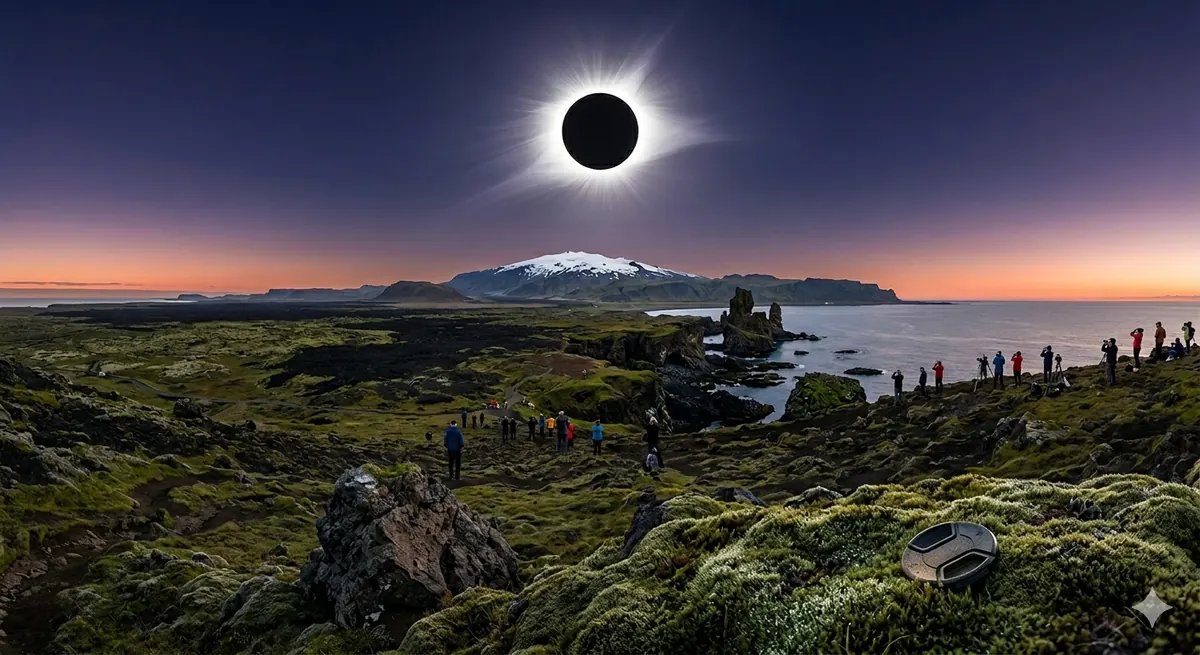
Total Solar Eclipse In Iceland, August 12, 2026
See totality in Iceland. The path of totality crossed the Westfjords, Snæfellsnes, and the southwestern peninsula. Best viewing locations, timing, and what you need to know.
The Only Total Solar Eclipse Visible From Iceland This Century
On August 12, 2026, a total solar eclipse crossed Iceland. The path of totality swept down from the Arctic and Greenland, across Iceland's Westfjords, Snæfellsnes, and the Reykjavík area, then out over the Atlantic toward northern Spain. In Iceland, totality lasted from just over a minute in Reykjavík to about 2 minutes 13 seconds at Látrabjarg in the far west, and then it doesn't happen here again until 2196.
While partial eclipses happen every few years, a total eclipse is much rarer and more dramatic. Something that only happens once in a lifetime for most people. To put this into perspective: the last total solar eclipse visible from Iceland was in 1954, and the next one after will be in 2196. In fact, since settlement in 870 AD, Iceland has only seen total of 12 solar eclipses, and even more so, this one was the first to be seen in Reykjavík in nearly 600 years!
This was a one-time event for everyone alive for this eclipse here in Iceland. If you've never seen a total solar eclipse, or if you have but want to experience it again, August 2026 in Iceland should have been on your list. The key was planning: location mattered, weather mattered, and everything booked up fast - if not already booked!
Best Locations For Total Eclipse In Iceland
The path of totality crossed Iceland diagonally. Duration decreased from northwest (longest) to southwest (shorter, but still worth it).
Westfjords
Látrabjarg
65.5026°N, 24.5366°W
Iceland's westernmost point and the longest land-based totality (max at 17:45:34). Dramatic sea cliffs and genuine isolation. The greatest eclipse point on Earth fell just 45 km off this coastline. Note: limited capacity, few services, and a one-way traffic system on the access roads (see traffic section below). The town of Patreksfjörður nearby still got ~2m 4s with far easier logistics.
Snæfellsnes Peninsula
Grundarfjörður (Kirkjufell)
64.9275°N, 23.3083°W
At the foot of Kirkjufell, Iceland's most photographed mountain, with paved access, town services, and an iconic foreground. For the longest totality on Snæfellsnes, head further west to Hellissandur, Malarrif, or Djúpalónssandur near the glacier. Those spots were the most congested with the fewest services, and the glacier's tip (Öndverðarnes) was shuttle-only. Traffic control ran across the peninsula from 12:00 to 19:00.
Southwest (near Keflavík airport)
Reykjanes Peninsula
63.8127°N, 22.7055°W
The closest path-of-totality region to Keflavík airport, roughly 30 to 45 minutes by car, and an easy drive from Reykjavík (the city itself only got about a minute of totality, so it paid to head out here). Reykjanes Lighthouse and Gunnuhver reached about 1m 47s, and the towns of Garður and Sandgerði just over 1m 40s, set against raw volcanic terrain including the new lava fields near Grindavík. The easiest logistics of any full-totality option, which also meant it was busy.
Westfjords (main town)
Ísafjörður
66.0748°N, 23.1350°W
The hub of the Westfjords, reachable by a short domestic flight from Reykjavík. Less totality than Látrabjarg but real town infrastructure and dramatic fjord scenery. Official gathering points at Safnahúsið and the Torfnes sports centre.
Eclipse Timing By Location
| Region | First Contact | Totality | Last Contact | Duration |
|---|---|---|---|---|
| Látrabjarg (Westfjords) | 16:43 | 17:44-17:46 | 18:45 | ~2m 13s |
| Ísafjörður (Westfjords town) | 16:43 | 17:44-17:45 | 18:44 | ~1m 31s |
| Grundarfjörður (Snæfellsnes) | 16:45 | 17:46-17:48 | 18:46 | ~1m 50s |
| Reykjanes Peninsula | 16:46 | 17:48-17:50 | 18:47 | ~1m 47s |
| Reykjavík city centre | 16:47 | 17:48-17:49 | 18:47 | ~1m 01s |
Times are local Iceland time (UTC+0, no daylight saving). All times are approximate; verify precise local timings at eclipse2026.is closer to the date.
Road Closures & One-Way Traffic On Eclipse Day
This was the single biggest logistical factor for 2026. Tens of thousands of people converged on a handful of small roads. Each region put temporary traffic-management plans in place, so plan around them, and do not expect to make last-minute drives.
Snæfellsnes Peninsula
Traffic control ran roughly 12:00 to 19:00. Útnesvegur (Road 574) ran one-way from Búðir to Hellissandur around the western tip, with reduced speed limits. Öndverðarnesvegur (Road 579) at the glacier's tip was closed to private vehicles, with shuttle access via Snæfellsjökull National Park. If you were connecting toward the Westfjords, note that Klofningsvegur (Road 590) in Dalabyggð also ran one-way. Use the official town gathering sites (Grundarfjörður/Kirkjufell, Stykkishólmur, Ólafsvík, Rif, Hellissandur).
Westfjords
One-way traffic was planned on the roads to Látrabjarg (Road 612 Örlygshafnarvegur and Road 614 Rauðasandsvegur), with 50-60 km/h limits. Bolafjall was closed to private cars (shuttle only). Roadside parking was prohibited; use town gathering sites such as Ísafjörður, Patreksfjörður, and Þingeyri.
Reykjanes Peninsula
One-way restrictions were planned on Road 420 (Vatnsleysustrandarvegur) and Road 45 (Ósabotnavegur), with monitored access on some smaller roads. Designated viewing sites included Reykjanes Lighthouse, Garðskagi, the Bridge Between Continents, and Fagradalsfjall.
Across the country, managed traffic and reduced speed limits began as early as 08:00 on eclipse day. The Icelandic Road Administration (Vegagerðin) published the official eclipse-day driving plan: vegagerdin.is.
The national plan above (Vegagerðin) and Reykjavík's city-centre arrangements were confirmed. Snæfellsnes, the Westfjords, and Reykjanes were still finalising exact viewing-site and traffic details, so confirm the latest before you travel at the official regional pages: West Iceland, Westfjords, Reykjanes, and Reykjavík.
Weather & Where To Stay
August Weather In Iceland
August is one of Iceland's most reliably pleasant months. Temperatures average 10-13°C, days are long (sunset around 10 PM), and most mountain roads and F-roads are open. It's also one of the best months for clear skies: Visit Iceland puts the odds at roughly a 40% chance of clear skies, which for an eclipse is genuinely workable. The southwest and west tend to be drier and sunnier than the Westfjords or the north. As with all Icelandic weather, conditions can change quickly, but August is genuinely a good month to be here, and far more forgiving than the rest of the year.
For the eclipse specifically, keep an eye on forecasts from about 3 days out. Icelandic Meteorological Office forecasts (en.vedur.is) are accurate at that range. If your chosen spot looks cloudy, the Snæfellsnes Peninsula or Reykjanes Peninsula are close enough to pivot to without abandoning your plans.
Accommodation Along The Path
The Westfjords and Snæfellsnes are popular in any August itinerary, and along the path of totality many hotels and guesthouses had been booked for several years. Campsites along the path generally run first-come, first-served (no reservations), so the regional tourism boards advised arriving at least a day before the eclipse. Reykjavík and the Reykjanes Peninsula have far more capacity and make a sensible base if you'd rather keep your options open and drive to your chosen spot.
What You Need For Eclipse Viewing
Essential
- ✓ISO 12312-2 certified solar eclipse glasses
- ✓Backup glasses
- ✓Good viewing location without cloud cover
- ✓Comfortable outdoor clothing (can be windy)
- ✓Patience (weather is unpredictable)
Nice To Have
- →DSLR/mirrorless camera + solar filter + telephoto lens, tripod recommended
- →Binoculars (see corona details during totality)
- →Portable chair or blanket (2 minutes is short, but standing is tiring)
- →Sunscreen (UV exposure is intense)
- →Snacks and water
Protect Your Eyes: This Is Not Optional
During every partial phase, before and after totality, you must wear ISO 12312-2 certified solar eclipse glasses. Ordinary sunglasses, however dark, will not protect you, and looking at the partial sun without certified filters can cause permanent eye damage. Never look at the partial sun through a camera, phone, binoculars, or telescope without a proper solar filter.
The only moment it is safe to look with the naked eye is during totality itself, the brief 1 to 2 minutes when the sun is 100% covered. Put your glasses back on the instant the first sliver of sun reappears. Buy certified glasses well in advance; they sell out in the weeks before a major eclipse.
Eclipse FAQ
What’s Your Next Step?
Two ways to keep planning - pick whatever fits where you are right now.
Quick gut-check
30 minute call with Erin ($80). Bring your questions or a draft itinerary - leave with a plan that fits your trip.
Book a consultation →Already have a plan?
Itinerary Review ($199). Send Erin your eclipse itinerary and get expert feedback on locations, timing, and weather backup plans before August 12, plus a follow-up call.
Get my itinerary reviewed →Before You Drive
Whatever the eclipse plans say, check live conditions on the day.
Essential Websites:
- icelandroads.com for a live interactive map of road closures, weather, and drive times across Iceland.
- safetravel.is for travel conditions, alerts, and to leave a travel plan.
- umferdin.is for live road and traffic conditions.
- road.is (Icelandic Road Administration) for road status and closures.
Join our Newsletter
Get Updates About The Eclipse And Other Iceland Travel Tips!
Seasonal advice, adventure inspiration, and other travel tips that don't always make it to social media.